Skip to content

Finding an injured bird on your sidewalk, lawn, or below a window triggers an instant urge to help. Your hands want to scoop it up, your mind races toward food, water, a warm blanket. Most of those instincts are right in spirit and wrong in practice, and the difference matters more than you might think. A few calm, correct moves in the first minutes can genuinely save a bird’s life, while a few well-meant mistakes can end it.
This guide walks you through exactly what to do when you find an injured bird: how to tell whether it needs help at all, how to contain it safely, what never to do, and how to get it into the hands of a licensed wildlife rehabilitator. The steps below follow guidance from wildlife rehabilitation professionals, including the National Wildlife Rehabilitators Association and the National Audubon Society.
First, Does the Bird Actually Need Help?
Before you touch anything, stop and watch. Many birds that look helpless are not in trouble at all, and intervening when nothing is wrong can do more harm than good. Give the bird ten to fifteen minutes of quiet observation from a distance.
Young birds are the most common false alarm. Fledglings leave the nest before they can fly well, hopping around with stubby tails while their parents feed them nearby. If the bird is feathered, alert, and hopping, its parents are almost certainly watching from above. Keep cats and dogs indoors and walk away.
Birds that have struck a window are the second most common false alarm. A stunned bird may sit motionless on the ground, breathing hard, eyes half closed. That looks alarming, but it is often simple concussion and shock.
Many of these birds recover on their own within fifteen minutes to two hours if left undisturbed in a safe spot. Popular Science’s guide to helping an injured bird describes the same approach: contain the bird gently, give it dark quiet time, and let it recover. For ways to prevent these collisions in the first place, see our guide on how to stop birds hitting windows.
If you are unsure whether a young bird is a fledgling or a nestling in real trouble, read our guide to what to do if you find a baby bird first. A few minutes of assessment prevents the most common rescue mistake: “rescuing” a bird that was doing fine.
Signs a Bird Truly Needs Rescue
After your observation period, look for concrete signs of injury. A bird needs your help if you see any of the following:
- Bleeding, open wounds, or blood on the feathers.
- A drooping wing, a wing held at an odd angle, or wings that are not symmetrical.
- A dangling leg or an obvious problem standing upright.
- It does not fly or hop away when you approach slowly.
- It is easily picked up, which almost never happens with a healthy wild bird.
- Eyes closed, crusty, swollen, or unfocused for an extended period.
- Panting, shivering, or labored breathing.
- It was caught by a cat or dog, even if you cannot see a wound.
- It is entangled in fishing line, netting, or string.
One important note on cat attacks: a bird your cat brought home needs professional care urgently, even when it looks unharmed. Cat saliva carries bacteria that can turn a tiny puncture fatal within hours. Get it to a rehabilitator the same day.
What You Will Need
You do not need special equipment. Everything on this list is probably already in your home:
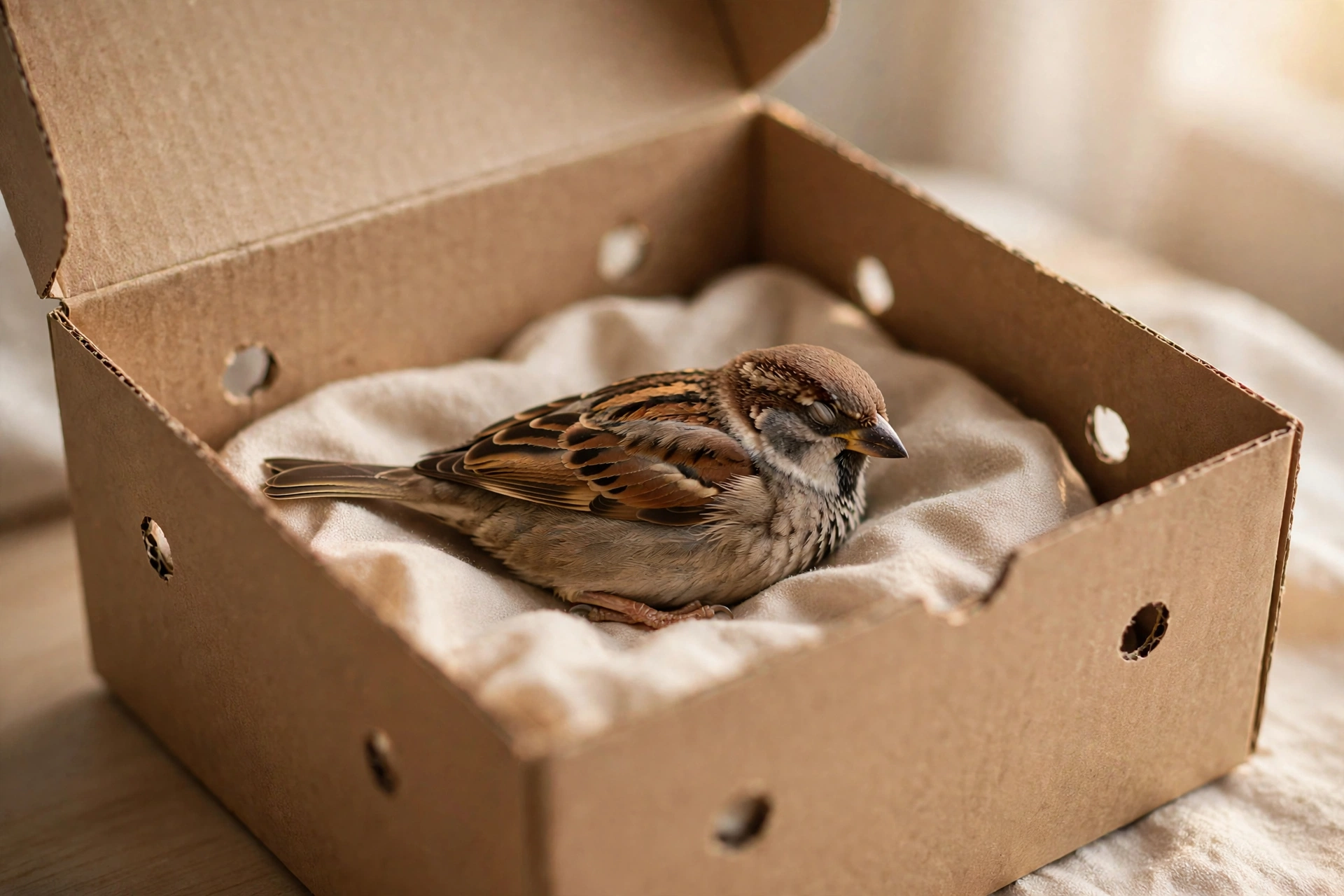
- Ventilated box: A clean cardboard box with a lid, with several small air holes punched from the inside out. A paper bag can work for a very small songbird in a pinch.
- Soft lining: A clean towel, an old T-shirt, or paper towels. Avoid terry cloth or looped fabrics, because tiny claws and toes can snag in the loops and break.
- Gloves: Gardening gloves, work gloves, or even winter gloves. They protect your hands from beaks and claws, and they protect the bird from the oils and bacteria on your skin.
- A towel or pillowcase: For gently covering the bird before you pick it up. Darkness calms birds quickly.
- A warm, quiet room: A bathroom, closet, or spare room away from pets, children, televisions, and kitchen noise.
- Optional heat source: A heating pad set on low placed under half the box, or a sealed hot water bottle wrapped in a towel on one side of the box. Never place heat under the entire box, so the bird can move away from it if it gets too warm.
- Your phone: To look up a wildlife rehabilitator and, if asked, to describe the bird and its condition.
Notice what is not on the list: food, water, medicine, and splints. You will not need any of those, and reaching for them is where most rescues go wrong.

Step by Step: How to Help an Injured Bird
Work slowly and quietly through these steps. Quick movements and loud voices spike a bird’s stress, and stress alone can kill. Birds go into shock very easily when injured, and many die from the shock itself rather than the wound.
- Prepare the box first. Line your ventilated box with the soft cloth and close the room off from pets and children before you approach. You want one smooth capture, not a chase.
- Approach slowly and cover the bird. Walk up calmly, drape the towel gently over the bird, then scoop it up, supporting its body. Keep your grip secure but light. Never squeeze or pin the wings with force.
- Place it in the box and close the lid. Set the bird down on the lining, remove your hands, and close the box. Darkness is calming, and a covered box does more for a frightened bird than anything else.
- Put the box somewhere warm, dark, and quiet. A closed bathroom or closet works well. Keep the room at a comfortable warm temperature. If the bird feels cold to the touch, add the heating pad on low under half the box or the wrapped hot water bottle on one side.
- Do not give food or water. This is the hardest rule to follow and the most important one. An injured bird can choke or inhale liquid into its lungs, and every species eats a different diet. A cold or shocked bird may be unable to swallow at all. Let the rehabilitator decide when feeding is safe.
- Contact a licensed wildlife rehabilitator. Call now, not later. Describe the species if you know it, the visible injuries, where you found the bird, and what happened, then follow their instructions exactly.
- Transport carefully. Place the closed box on a stable car seat, buckled in or wedged so it cannot slide. Keep the car quiet: radio off, talking to a minimum, no air conditioning blasting on the box. Never carry the bird in your hands. Hand it to the rehabilitator with a short note about where and when you found it.
That is the entire procedure. Contain, calm, warm, call. You are the bridge between the moment of injury and professional care, and that bridge is exactly as valuable as it sounds.
What NOT to Do: The Critical Mistakes
Most injured birds that die in human care are not killed by their injuries. They are killed by good intentions applied incorrectly. Memorize this table:
| Do This | Not This |
|---|---|
| Observe from a distance first | Grab the bird the moment you see it |
| Wear gloves before handling | Handle with bare hands |
| Use a ventilated box with a lid | Use an open container or a wire cage |
| Keep the bird warm, dark, and quiet | Offer food or water |
| Call a licensed rehabilitator promptly | Try to diagnose or treat injuries yourself |
| Transport in a closed, secure box | Carry the bird in your hands in the car |
| Keep pets and children away | Let people handle or photograph the bird repeatedly |
Two of these deserve emphasis. Never attempt to set a broken bone or fashion a splint: a badly set wing can heal crooked and leave the bird permanently flightless. Never apply creams, ointments, or home remedies to wounds. Birds preen, so anything on the feathers gets ingested, and many common products are toxic to them.
And resist the urge to check on the bird every few minutes. Every time the lid opens, the bird’s stress spikes back up. Peek once to confirm it is alive and breathing, then leave it alone until transport.
Special Situations
Window strikes
If a bird hits your window and is alive but dazed, it may simply need time. Move it gently into a ventilated box and place it somewhere safe, dark, and quiet, checking every fifteen to thirty minutes.
If it becomes alert and active, take the open box to a sheltered spot away from traffic and let the bird leave on its own. If it cannot fly properly after one to two hours, or if you see any sign of injury, it needs a rehabilitator.
Cat or dog attacks
As noted above, any bird caught by a cat needs same-day professional care, even without visible wounds. Punctures from teeth can be nearly invisible under feathers, and infection sets in fast. Keep the bird boxed, warm, and untouched, and tell the rehabilitator it was a cat attack so they can start treatment immediately.
Raptors, herons, and large birds
Do not attempt to handle a hawk, owl, eagle, heron, or any large bird yourself. Talons and beaks built for hunting can cause serious injuries to people, and a frightened large bird is far stronger than it looks. Keep people and pets well back, note the exact location, and call a wildlife rehabilitator, animal control, or your local wildlife agency for capture help. This is the one case where calling first and handling never is the correct sequence.
Baby birds
A feathered baby hopping on the ground is usually a fledgling with parents nearby. A featherless baby on the ground is a nestling that genuinely needs help: place it back in its nest if you can find it, or in a makeshift nest secured in the same tree. Parent birds will not reject a baby you have touched. If no nest can be found or the baby is injured, contain it as described above and call a rehabilitator.

How to Find a Licensed Wildlife Rehabilitator
A licensed wildlife rehabilitator is trained and permitted by wildlife authorities to treat injured wild animals. They have the medical knowledge, proper diet supplies, recovery cages, and legal permits. Finding one is usually straightforward:
- Use the National Wildlife Rehabilitators Association directory: The NWRA maintains resources to help you locate a permitted rehabilitator in your area. Their found-wildlife page walks you through exactly what to do next.
- Try Animal Help Now: The Animal Help Now website and free app match your location with nearby wildlife helpers, including rehabilitators, rescues, and hotlines. It is one of the fastest ways to find help in an emergency.
- Call local animal control or your state wildlife agency: If you cannot reach a rehabilitator directly, animal control officers and wildlife agencies can usually connect you with one or arrange transport.
- Ask a veterinarian: Many vets will provide basic stabilizing care for wildlife and can refer you to a rehabilitator. Call ahead first, since not every clinic accepts wild animals.
Rehabilitators are often volunteers juggling dozens of animals, so if your first call goes unanswered, keep trying others on the list. When you do reach someone, have the key facts ready: the species or a description, what happened, the visible injuries, and exactly where you found the bird.
The Legal Side: Why You Cannot Keep a Wild Bird
In the United States, the Migratory Bird Treaty Act of 1918 makes it illegal to possess, capture, or keep most native wild birds without a federal permit. The law covers over one thousand species, from hummingbirds to hawks, along with their nests, eggs, and feathers. Trying to nurse an injured bird back to health at home, however kindly meant, is technically possession under this law.
The law exists for the bird’s benefit. Wild birds have precise dietary and medical needs that take training to meet, and well-meaning home care so often ends badly that the permit system routes injured birds to qualified people. Briefly containing a bird and transporting it to a rehabilitator is exactly what the system expects of you.
Outside the United States, the specific law differs but the principle is the same nearly everywhere: wild birds are protected, and rehabilitation requires authorization. A quick search for your country’s wildlife authority will tell you who is licensed to help. This is also one more reason why bird conservation matters more than ever: individual rescues save individual birds, but legal protection saves populations.
After the Rescue: What Happens Next
Once you hand the bird over, the rehabilitator takes it from there. They will assess the injuries, provide warmth and fluids, treat wounds, set fractures properly, and feed the correct diet for the species. Recovery happens in stages: intensive care, then a flight cage where the bird rebuilds strength, then a final health check before release back into suitable habitat.
Not every rescue ends in release. Some injuries are too severe, and some birds succumb to shock despite excellent care. Rehabilitators decide based on whether the bird can survive in the wild, which is the only outcome that counts.
Do not expect detailed updates. Most centers are stretched thin and cannot report on every animal. At drop-off, ask whether the center accepts donations. Wildlife rehabilitation runs largely on private generosity, and your contribution helps the next injured bird through the door.

Frequently Asked Questions
Should I give an injured bird water?
No. Never give food or water to an injured wild bird unless a licensed rehabilitator specifically instructs you to. Injured birds can inhale liquid into their lungs, and a shocked bird may be unable to swallow safely. The wrong food can cause serious digestive harm, since every species has a different diet. Keep the bird warm, dark, and quiet instead.
Can I keep the bird at home until it heals?
No. In the United States the Migratory Bird Treaty Act makes it illegal to possess most wild birds without a permit, and similar protections exist in most countries. Proper treatment also requires training: setting fractures and feeding species-correct diets are skilled work, and well-meant mistakes frequently prove fatal. Your role is safe transport to a professional.
What if I cannot find a rehabilitator?
Keep trying. Call animal control, your state wildlife agency, and local veterinary clinics, and use the Animal Help Now directory to widen your search. Meanwhile, keep the bird in its warm, dark, quiet box with no food or water, and check on it as rarely as possible.
The bird flew away after resting. Is it definitely okay?
Probably, but watch the departure. Strong, level, controlled flight is a good sign that it has shaken off the concussion. Wobbly or low flight means you should try to recapture it and call a rehabilitator.
My cat brought me a bird and it looks fine. Should I just let it go?
No. Any bird caught by a cat needs same-day evaluation by a rehabilitator, even with no visible wounds. Tooth punctures hide easily under feathers, and bacteria from cat saliva can cause fatal infection within hours. Call a rehabilitator immediately and mention the cat attack so treatment starts without delay.
Conclusion
Helping an injured bird comes down to four calm actions: observe first, contain safely in a warm dark box, give nothing to eat or drink, and get the bird to a licensed rehabilitator. You do not need medical training or special equipment, just a cardboard box, a towel, a pair of gloves, and the discipline to resist feeding, treating, or keeping the bird yourself.
The hardest part of a rescue is often accepting the limits of your role. You are the first link in a chain that ends with a trained professional, and that link matters enormously. A bird that arrives at a rehabilitation center warm, calm, and un-fed has a far better chance than one that arrives stressed, chilled, or harmed by well-meant home treatment. Do your part well, hand the bird over, and know that you gave it the best possible start.