 Skip to content

Every spring, birds pour astonishing energy into building nests, weaving twigs, mud, grass, and feathers into nurseries that hold their eggs. Then, months later, many of those carefully built structures sit empty and abandoned. It raises an obvious question for anyone watching backyard birds.
Do birds reuse their nests? For most small songbirds, the answer is no. They build a fresh nest for each breeding season, and often for each brood within a season. But the bird world is full of exceptions. Eagles and storks may return to the same massive nest for decades, barn swallows repair and reuse their mud cups year after year, and cavity nesters like bluebirds happily move back into the same hole each spring.
In this article, you will learn which birds reuse their nests and which never do, why most songbirds start fresh, the advantages and risks of reuse, what cavity nesters do differently, and what you should do if you find an old nest in your yard or on your house.

Do Birds Reuse Their Nests? The Short Answer
Whether birds reuse their nests depends almost entirely on the species. As a general rule, large birds with sturdy nests reuse them, and small birds with flimsy nests do not. A bald eagle’s stick platform can last for decades with annual repairs, while a mourning dove’s loosely assembled twig platform may fall apart before the chicks even fledge.
Most small open-cup nesters, including robins, cardinals, and finches, build a new nest for each breeding attempt. American robins may raise up to three broods in a single season, and they typically construct a new nest for each one. The old nest, weakened by weather, growing chicks, and parasites, simply is not worth salvaging.
At the other end of the spectrum, raptors, herons, storks, and swallows treat their nests as long-term real estate. They return to the same structure year after year, adding fresh material each season. Between these extremes sit the cavity nesters, which reuse the hole or box but usually rebuild the soft lining inside.
Why Most Small Birds Build a Fresh Nest Every Year
Starting over looks wasteful, but for small birds it is the safer bet. An old nest carries three serious problems that a new one avoids.
Parasites Build Up
Old nesting material harbors mites, lice, fleas, and other parasites that feed on nestlings. A fresh nest gives chicks a cleaner start. Research on cavity-nesting birds has repeatedly shown that parasite loads climb in reused nests, which is one reason even species that reuse cavities usually throw out the old lining and rebuild it.
Structure Weakens
A nest that survived one brood has endured weeks of rain, wind, sun, and the growing weight of chicks. Twigs loosen, mud crumbles, and grass rots. Many small-bird nests are not durable enough to survive a second round, and a collapse mid-season would be catastrophic. Building fresh is structural insurance.
Predators Remember Locations
A nest that successfully raised chicks has advertised its location to every predator in the neighborhood. Jays, crows, snakes, and raccoons learn where nests are. Moving to a new site, even a few yards away, resets that risk. Birds that reuse nests accept this cost because their nests are in defensible spots, high cliffs, sturdy treetops, or inside cavities.
There is also a simple matter of instinct. Many songbirds appear hardwired to build, and the act of nest building itself is part of courtship and pair bonding. For these species, skipping construction would mean skipping a step their breeding biology expects.
The Loyal Reusers: Birds That Return Year After Year
For some species, the old nest is too valuable to abandon. These birds invest in maintenance instead of new construction, and the results can be spectacular.
Eagles, Hawks, and Ospreys
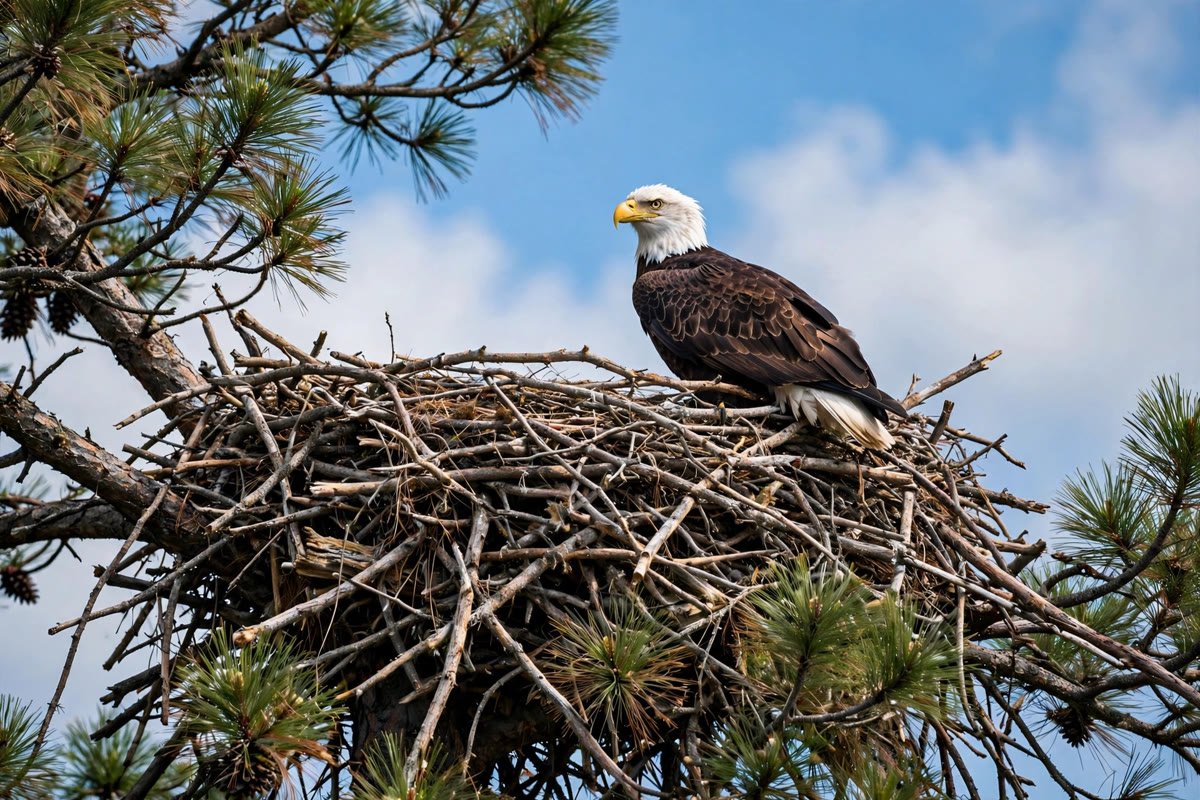
Large raptors are the most famous nest reusers. A bald eagle pair returns to the same eyrie each year, adding new sticks, grasses, and soft lining every season. Over years and decades, these nests grow into enormous structures that can weigh hundreds of pounds or more.
Ospreys do the same on platforms, dead trees, and even utility poles, which is why wildlife agencies install dedicated nesting platforms for them. Red-tailed hawks and great horned owls also reuse large stick nests, and great horned owls often skip building entirely by taking over an old hawk or crow nest.
Herons, Egrets, and Storks
Colonial waterbirds are dedicated renovators. Great blue herons return to the same treetop colonies, called heronries, each spring and refurbish last year’s stick nests with fresh twigs. White storks in Europe are legendary for this: returning migrants reclaim the same rooftop or chimney nest, adding to it year after year until the structure becomes impressively large and heavy.
Barn Swallows and Other Mud-Nesters
Barn swallows build their cup nests from mud pellets, and a well-built mud nest is remarkably durable. Studies have found that nearly half of barn swallow pairs reuse their old nest in a given year, and a single mud nest may be repaired and reused for a decade or more by successive generations of swallows.
This loyalty makes sense. A good nest site under an eave or inside a barn is sheltered, proven, and close to foraging areas. The birds simply patch cracks, add a fresh mud rim, and line the cup with new feathers.
Cavity Nesters: Reusing the Hole, Not the Nest
Cavity nesters take a middle path. Woodpeckers, the primary excavators, usually carve a fresh cavity each year, which is generous of them: their abandoned holes become prime real estate for everyone else. Secondary cavity nesters like eastern bluebirds, chickadees, titmice, and tree swallows cannot excavate, so a good cavity is precious.
These birds readily reuse the same cavity or nest box year after year. What they typically do not reuse is the old nesting material. Bluebirds, for instance, will clean out or build over the previous season’s debris and lay down fresh grass and pine needles. This is why cleaning out birdhouses in fall is such a helpful practice: you are doing the housekeeping the birds would do themselves.
If you want to host these loyal tenants, our guide to attracting bluebirds to your yard covers nest box placement and maintenance in detail.

Which Strategy Wins? The Trade-Offs of Reuse
Neither strategy is universally better. Each solves a different set of problems, and the species that thrive are the ones whose strategy matches their nest type and lifestyle. So when we ask whether birds reuse their nests, we’re really asking which strategy a species has committed to.
| Factor | Building fresh (robins, cardinals) | Reusing (eagles, swallows) |
|---|---|---|
| Energy cost | High: full construction each time | Low: repairs only |
| Parasite risk | Low: clean materials | Higher: old material harbors mites and lice |
| Structural safety | High: new and sturdy | Depends on maintenance; old nests can fail |
| Predator risk | Lower: new, unknown location | Higher: predators remember the spot |
| Speed of breeding | Slower: must build first | Faster: can lay eggs sooner |
| Site quality | Unknown until tested | Proven: it worked before |
Notice the pattern: reuse trades safety for speed and economy, while fresh building trades speed for safety. Large birds can afford the safety cost because their nests sit in defensible places and they can fight off most threats. Small birds cannot, so they pay the construction cost instead.
Timing matters within a season too. A robin raising three broods builds three nests, but if a first attempt fails early, many species will renest quickly, sometimes reusing the same nest if it is still intact. Flexibility beats any single rule.
What to Do About an Old Nest in Your Yard
Finding an empty nest on your property raises practical questions, especially when it is tucked into a vent, gutter, or porch light. Here is how to handle it responsibly.
- Check whether it is active: if eggs or chicks are present, or adults are regularly visiting, leave it completely alone. Disturbing an active nest of a native bird is illegal under the Migratory Bird Treaty Act in the United States.
- Wait until the season ends: once the young have fledged and the adults have stopped visiting for a few weeks, the nest is inactive and may be removed where the law allows.
- Clean nest boxes, not natural nests in trees: an old robin nest in a shrub will decay on its own and may even provide material for other birds. Nest boxes, however, benefit from annual cleaning, which reduces parasites for next year’s tenants.
- Leave swallow nests in place: barn swallows often return to the same mud nests. If the nest is not causing damage, leaving it up invites the birds back next spring.
- Watch for re-nesting: some birds build a second nest nearby after a failed attempt. Give them space and time before assuming a site is abandoned for good.
If you find a fallen baby bird near an old nest, resist the urge to “rescue” it into the wrong nest. Our guide on what to do if you find a baby bird walks through the right steps. And if you are curious about the full timeline from egg to fledgling, see how long bird eggs take to hatch by species.
Common Myths About Nest Reuse
- Myth: Birds live in their nests year-round. Most birds use nests only for breeding. Outside the nesting season, they roost in trees, shrubs, or cavities, and the old nest sits empty.
- Myth: If a bird abandons a nest, something is wrong. Abandoning the nest after the young fledge is completely normal. Most songbirds never look back.
- Myth: You should always tear down old nests to “help.” Old nests in natural spots decay harmlessly and may shelter insects or provide nesting material for other birds. Only nest boxes truly need human cleaning.
- Myth: Touching a nest makes birds abandon it. Most birds will not abandon a nest because a human touched it; they identify their young by location and sound, not smell. Still, minimize disturbance, especially during incubation.
- Myth: Big nests are built big in one season. The giant eagle and stork nests people photograph are the work of many years of additions, not a single heroic construction effort.

Frequently Asked Questions
Do robins reuse their nests?
Almost never. American robins typically build a new nest for each brood, and they may raise up to three broods in a season. The mud-and-grass cup weakens quickly, and a fresh nest avoids the parasites and structural problems of the old one. If you see a robin building where a nest stood before, it is usually constructing an entirely new nest on or near the old site.
How long can a bald eagle use the same nest?
Many years, potentially decades. A mated pair returns to the same eyrie each breeding season and adds fresh material annually. Over time these nests become enormous, weighing hundreds of pounds. The pair bond and the nest site bond often last for the birds’ whole lives together.
Do birds reuse nests from other species?
Yes, this is common. Great horned owls famously raise their young in old red-tailed hawk or crow nests instead of building their own. Many small cavity nesters move into abandoned woodpecker holes. Even the nesting material gets recycled: birds frequently steal twigs, moss, and feathers from old nests to build new ones.
Should I remove an old bird nest from my porch?
Only after you are certain it is inactive. Wait until the breeding season is over and no adults are visiting. An inactive nest of a native species may be removed, but never disturb an active nest with eggs or chicks. Barn swallow mud nests are worth leaving in place, since the birds often return to them.
Do birds clean their own nests?
Many do, in limited ways. Adult birds carry fecal sacs away from nestlings, keeping the nest relatively clean during the breeding cycle. Cavity nesters often remove old lining before laying new eggs. But no bird fully sterilizes an old nest, which is why nest boxes benefit from a human cleaning each fall.
Why do some birds build multiple nests but only use one?
House wrens are famous for this: the male builds several “dummy” nests of twigs in different cavities, and the female chooses one and adds the soft lining. The extra nests may confuse competitors and predators, or simply give the female options. Bluebirds do something similar on a smaller scale, starting nests in multiple holes before settling on one.
Conclusion
Do birds reuse their nests? The honest answer is that it depends on the bird, the nest, and the math of survival. Small songbirds bet on fresh construction, paying in energy to buy safety from parasites, collapse, and predators. Eagles, storks, herons, and swallows bet on real estate, maintaining proven structures that grow more valuable with each passing year.
Cavity nesters split the difference, reusing the precious hole while refreshing the bedding inside. And every strategy bends when circumstances demand it, with renesting after failure and material theft between species keeping the whole system flexible.
For the backyard observer, this means the empty nest in your shrub is not a failure. It is a finished job. Leave the swallow nests under your eaves, clean out your nest boxes each fall, and give active nests the wide berth the law and basic decency require. The birds have been solving the housing question for millions of years, and they are better at it than we are.




