 Skip to content

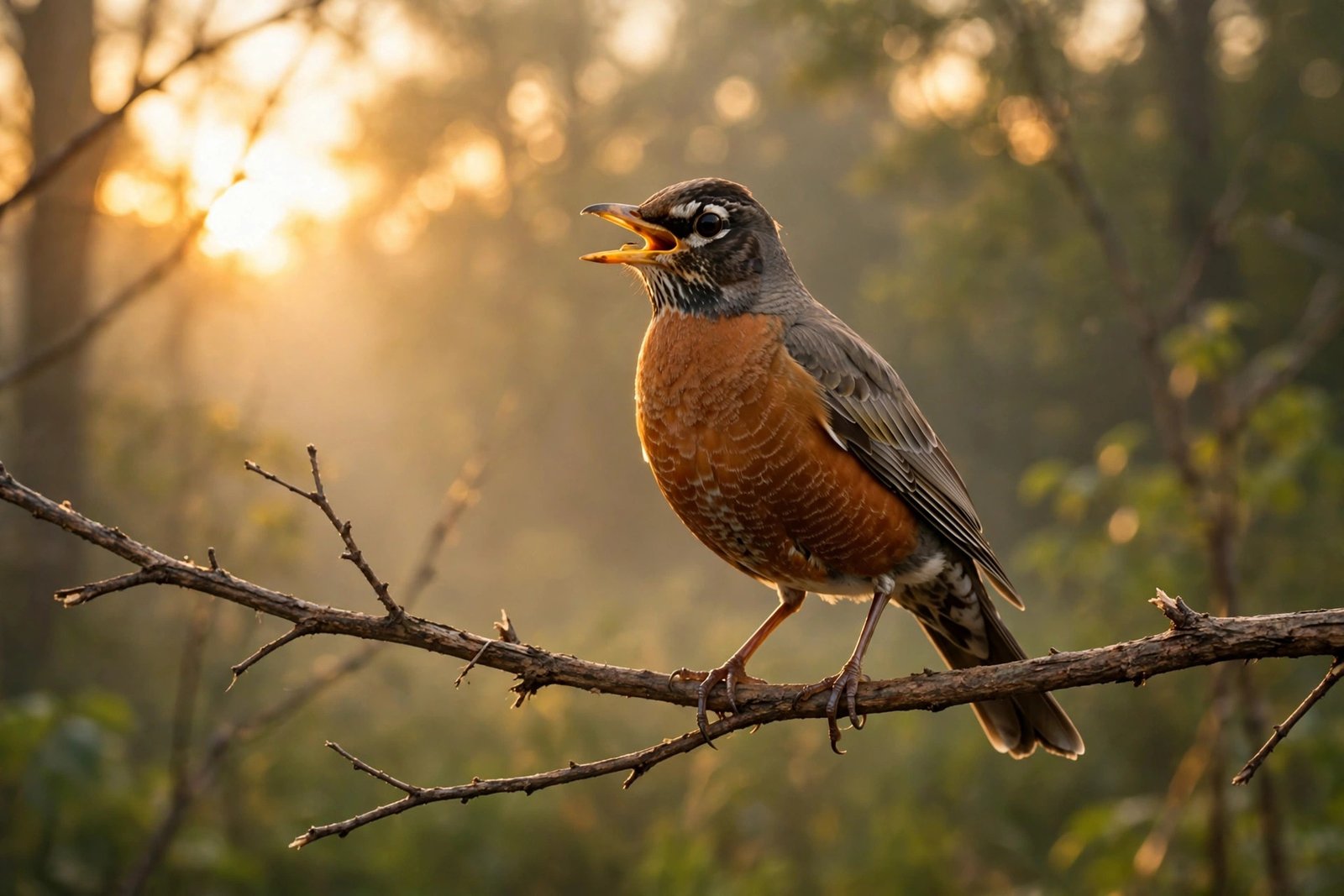
At 4:45 on a May morning, a single robin starts to sing outside your window. Within minutes a wren piles on, then a cardinal, then a blackbird, until the whole neighborhood is ringing with sound. This daily performance has a name: the dawn chorus. But why do birds chirp in the morning with such urgency, and why does the concert fade by late summer?
The short answer is that dawn is when singing pays off most. Cool, still air carries song farther. Rising light triggers a hormonal surge in males. And the dim hour before foraging begins is the perfect window for advertising territory and fitness to every bird within earshot. In this guide, you will learn what the dawn chorus is, the science behind why it happens at sunrise, which birds sing first, whether females join in, and why the music goes quiet in fall.
What Is the Dawn Chorus?
The dawn chorus is the surge of birdsong that builds in the 30 to 90 minutes around sunrise. It happens on every continent where songbirds live, and it follows the same pattern everywhere: a few early voices in the dark, then a rapid crescendo as more species join in, then a gradual taper as the sun climbs and the birds turn to feeding.
The chorus is loudest during the breeding season, roughly March through July in the Northern Hemisphere. In the Upper Midwest, the richest mornings arrive in mid-May, when spring migrants have settled onto territories and every male has something to prove. By late summer the performance thins out, and by midwinter most mornings are nearly silent.
Birders love it so much they gave it its own holiday. International Dawn Chorus Day falls on the first Sunday of May and traces back to Birmingham, England, in 1984. Thousands of people now set an alarm, open a window, and simply listen.
Why Sound Carries Farther at Dawn
One reason dawn works so well for singing is physics. In the early morning the air is cool and dense, humidity is high, and the wind is usually calm. Sound travels farther and with less distortion under those conditions than it does in the warm, turbulent air of midday.
Heather Williams, a professor at Williams College who studies the neuroscience of birdsong, told National Geographic that cooler, denser air lets sound travel farther, and that higher humidity helps fine song details survive the trip. The Woodland Trust goes further, noting that birdsong may carry up to 20 times farther at dawn than later in the day.
There is also far less competition for the airwaves. Traffic, lawnmowers, and human activity are mostly asleep, so a song cuts through cleanly. A bird singing at dawn is broadcasting to the largest possible audience at the lowest possible cost.
That said, scientists debate how much of the chorus the acoustics really explain. A Cornell-led analysis of singing patterns across dozens of species found that territory defense and mate signaling fit the dawn peak better than sound transmission alone. Cornell ornithologist Mike Webster puts it plainly: why everything happens at dawn is still an open question, with no full consensus. The honest picture is that several forces combine, and sound physics is only one of them.
The Hormone Story: Light, Testosterone, and the Internal Clock
Birds run on an internal clock synced to the 24-hour light cycle. As light levels rise before sunrise, photoreceptors in the brain detect the change and set off a hormonal cascade that prepares the body for the day.
In male songbirds, testosterone surges during the breeding season and peaks right around dawn. Higher testosterone means stronger motivation to sing and defend territory, and males with the highest levels tend to start earlier and sing longer. Meanwhile melatonin, the hormone of darkness, drops as dawn approaches, releasing a brake on activity.
Researchers studying zebra finches recently described what they call the rebound singing hypothesis. During the night, darkness suppresses the urge to sing, so motivation builds up like water behind a dam. When light returns, the pent-up drive is released as an intense burst of song. The same work showed that dawn singing also functions as a vocal warm-up: birds lose a little precision during long silence, and the first songs of the day help them recover full control before the serious business of courtship begins.
This hormonal engine also explains the season. Long spring days drive testosterone up; the shorter days of fall let it fall again. When the hormones fade, so does the singing. The chorus is, in a real sense, the sound of spring chemistry.
The Real Business: Territory and Mates
If you ask what the singing is for, the best-supported answer is social: territory defense and mate attraction.
Dawn is when neighboring males are most likely to probe boundary lines after a night apart. A male that sings loudly and steadily at first light tells every rival nearby that his territory is occupied and actively defended. That announcement can prevent costly physical fights later in the day.
For females listening nearby, the dawn song is a fitness advertisement. A male singing hard before he has eaten is saying, in effect: I survived the night, I am healthy, and my territory is still mine. Song complexity matters here too. A long, varied, precisely delivered song is harder to fake than a short one, so females can judge quality by listening. Unpaired males sing longer and more intensely than mated ones, because each dawn is a fresh chance to attract a mate.
Some species take this so seriously that they keep special songs just for the occasion. According to Cornell’s Mike Webster, certain birds perform songs during the dawn chorus that they never sing at any other time of day. The dawn set list is literally different from the daytime one.
Why Not Eat Breakfast Instead?
Singing burns energy, so why spend the first hour of the day on it instead of foraging? Because foraging would be a poor use of that hour anyway.
In the dim light before sunrise, insects are still inactive, seeds are hard to spot, and a bird hunting by sight gains little. At the same time, low light makes it harder for predators to spot a singing bird. Dawn is a dead window for feeding and a safe window for singing, so birds fill it with the social work of the day.
There is a practical logic here that birders have long suspected. Once the sun is up and insects are moving, the same birds go quiet and get to work. The chorus is not wasted energy. It is scheduled around the foraging day, not instead of it.

Who Sings First: The Morning Lineup
The dawn chorus is not a free-for-all. Each species has its own entrance time, and the order is remarkably consistent from day to day.
In North America, American robins are usually first, often starting 45 minutes or more before sunrise, sometimes as early as 4 a.m. in spring. Thrushes, blackbirds, and wrens follow close behind. Cardinals and woodpeckers join as the sky brightens, while sparrows and finches tend to wait until there is enough light to see by.
The Woodland Trust describes a similar sequence in Britain: robins, blackbirds, and thrushes open, woodpigeons, wrens, and warblers follow, and tits, sparrows, and finches close the show. The pattern holds across continents even though the cast changes.
Why this order? Timing is precise within each species, and one likely factor is vision. Birds with relatively larger eyes can gather enough light to be active earlier, which may explain why robins beat finches to the microphone. Researchers have also linked each species’ start time to the sensitivity of its visual system, so the lineup appears tuned by evolution to reduce overlap, letting every singer be heard.
How to Catch the Dawn Chorus Yourself
You do not need special equipment to enjoy the chorus, but a little planning helps.
- Set your alarm: Aim to be outside or by an open window 45 to 60 minutes before sunrise. Check your local sunrise time the night before.
- Pick the right months: Late April through June offers the richest chorus in most of North America. May is the peak in many regions.
- Find good habitat: Parks, woods, and leafy suburbs beat open lawns. Even a street with mature trees works.
- Sit still and listen: The first singer is easy to miss. Give it ten quiet minutes and the rest of the cast will arrive.
- Identify as you go: The free Merlin Bird ID app can listen and name singers in real time, which turns a pleasant morning into a lesson.
For more on timing your outings, see our guide to the best time of day to see birds. If you are new to the hobby, our bird-watching for beginners guide covers the basics.

Do Female Birds Sing in the Morning Too?
Most people assume only males sing. In the temperate dawn chorus, that is mostly true, but the full story is more interesting.
A landmark 2014 study by Karan Odom and colleagues found that female song is present in 71 percent of surveyed songbird species, and that singing females were likely the ancestral condition, not a rare exception. Scientific American reports that females are now known to sing in more than 660 species, with thousands more still unstudied. Much of the old male-only assumption came from geographic bias: early ornithology focused on northern temperate birds, where females sing less, and missed the tropics, where duetting pairs are the norm.
Northern cardinals are a familiar exception close to home. Females sing full, complex songs, often in duets with their mates. Carolina wrens do the same, with the female adding a buzzy trill over the male’s song. In these species, a dawn duet tells listeners that the territory has two defenders, not one.
So if you hear a cardinal singing at dawn, do not automatically picture the bright red male. It might be his mate, and she has been underestimated for more than a century.
Why the Chorus Fades by Fall
By August, the mornings go quiet, and many people assume the birds have left. Most have not. They have simply stopped singing, and the reasons are straightforward.
The jobs are done
Mates are paired, territories are settled, and young are raised or nearly so. With no rivals to warn and no mates to impress, the payoff for singing collapses. Fall migration is famously quiet for the same reason: birds on the move have nothing to defend.
The hormonal engine winds down
As days shorten, testosterone falls, and research on song sparrows at the University of Washington showed that the brain regions controlling song actually shrink in the fall. Songs become sloppier and less frequent. One researcher noted that if you listen closely, you can hear the difference: fall songs drop notes and lose their spring crispness.
Molt takes over
Late summer brings the annual molt. Replacing feathers over several weeks is energy-intensive, and a molting bird with compromised flight stays in dense cover and keeps quiet. It is maintenance season, not performance season. Feeders often go oddly quiet in August for exactly this reason.
The chorus through the seasons
The silence does not last forever. As early as January, chickadees and cardinals start testing their spring songs again, quiet rehearsals for the months ahead. By March the chorus is building, May brings the peak, and the cycle turns again. Once you know the pattern, you can set your calendar by it.
Dawn vs Dusk vs Night: A Quick Comparison
Birds sing at other times too, but nothing matches the dawn peak. Here is how the three periods compare.
| Feature | Dawn Chorus | Dusk Singing | Night Singing |
|---|---|---|---|
| Timing | 30 to 90 minutes around sunrise | Last hour before dark | After dark |
| Main singers | Many male songbirds | Fewer species, shorter bouts | Specialists such as mockingbirds, owls, and nightjars |
| Main purpose | Territory defense and mate attraction | Final territorial claims and roost coordination | Territory defense and nocturnal migration calls |
| Intensity | Peak of the day | Moderate | Low, except for specialists |
Night singing is a different phenomenon with different causes, from artificial light to nocturnal migration. If late-night song is your mystery, our guide to why birds chirp at night covers it in detail.

Frequently Asked Questions
What is the dawn chorus?
The dawn chorus is the daily surge of birdsong that builds in the 30 to 90 minutes around sunrise. It peaks during the breeding season, when male songbirds sing to defend territories and attract mates.
Which birds sing first in the morning?
American robins usually open the show, often 45 minutes or more before sunrise. Thrushes, blackbirds, and wrens follow, with cardinals, sparrows, and finches joining as the light grows.
What time do birds start chirping?
Most species begin 30 to 90 minutes before sunrise, with exact timing varying by species, season, and latitude. In spring, the first songs can start as early as 4 a.m.
Why do birds stop chirping in fall?
Breeding ends, so the reasons to sing disappear. Testosterone falls, song-control brain regions shrink, and many birds go through an energy-intensive feather molt that keeps them quiet and hidden.
Do female birds sing in the morning?
Sometimes. Research has found female song in 71 percent of surveyed songbird species, and female northern cardinals and Carolina wrens sing regularly. In temperate regions, though, the dawn chorus is still dominated by males.
Why do birds chirp at 3am?
Middle-of-the-night singing usually has different causes: artificial light confusing a bird’s clock, nocturnal migrants calling in flight, or persistent singers like mockingbirds. It is a separate topic from the dawn chorus, covered in our night-chirping guide.
Can I hear the dawn chorus in the city?
Yes, though it starts earlier and sounds thinner. Urban birds often sing before traffic builds, and some shift their timing to dodge noise. Studies have found that artificial light and city noise can change when the chorus begins, but parks and leafy streets still host a respectable performance in May.
Conclusion
So why do birds chirp in the morning? Because dawn is the hour when a song does the most work. Cool, still air carries it farther. Rising light fires up the hormones that drive males to sing. And the dim stretch before foraging begins is the ideal time to claim a territory, advertise fitness, and remind every rival that the singer survived the night.
The science is still settling the exact balance between physics, hormones, and social strategy, and researchers like Cornell’s Mike Webster are candid that no single explanation has won. What is certain is that the chorus is not random noise. It is a timed, tuned, and purposeful performance, and it fades each fall only because its work is done.
Set an alarm for a May morning, open the window about an hour before sunrise, and listen for the robin that starts it all. Once you know what you are hearing, you will never sleep through it the same way again.




