 Skip to content

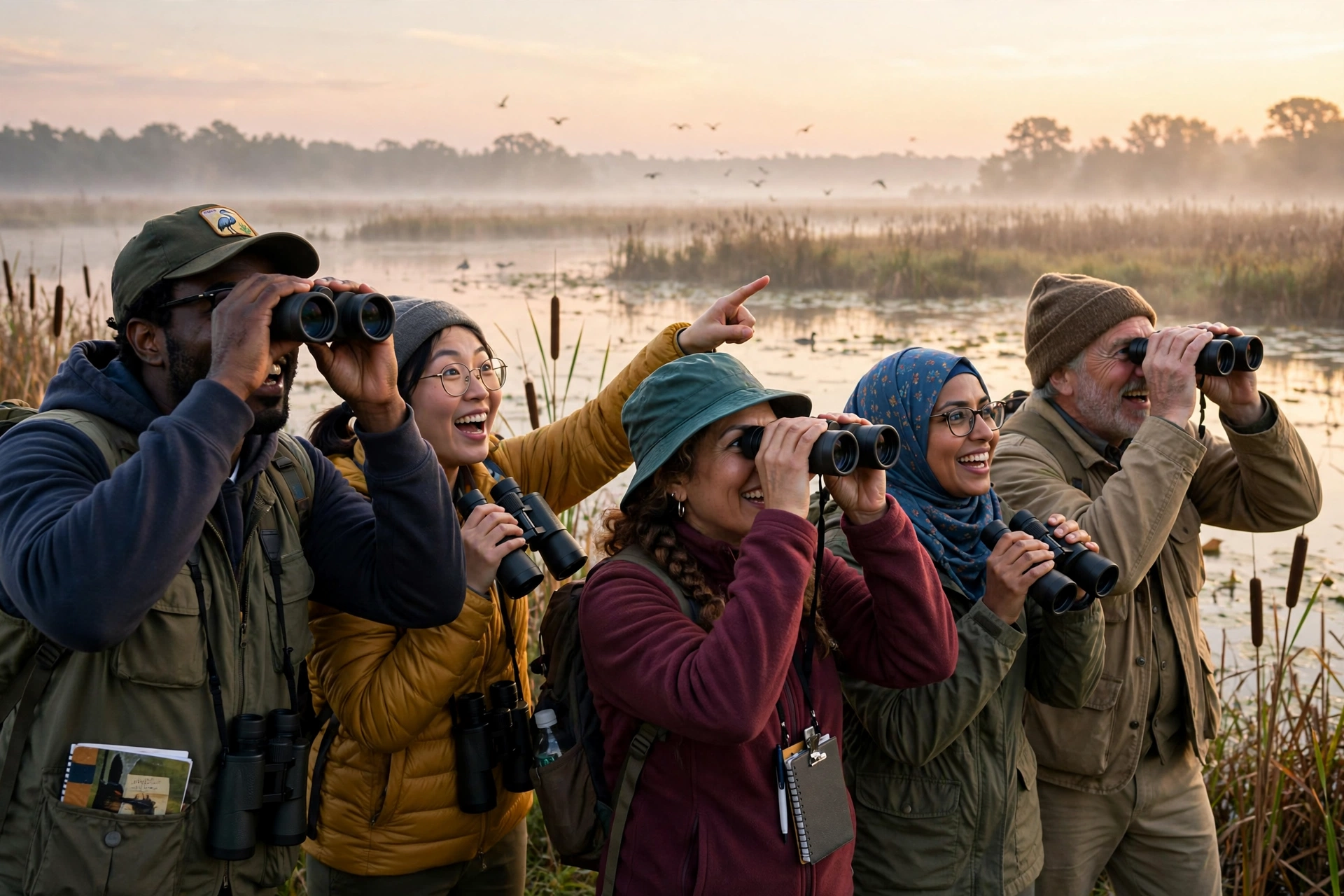
This Saturday, October 10, 2026, is the biggest birding day of the fall. Nearly 900,000 people took part last year, and the Cornell Lab of Ornithology wants to push past one million this time. It costs nothing, it takes as little as ten minutes, and you can do it from your own backyard.
October Big Day is eBird’s global celebration of birds, and this year it lands on a remarkable weekend. The event coincides with World Migratory Bird Day and sits at the heart of Global Bird Weekend, which runs October 9 to 11. While millions of migrants stream toward their wintering grounds, birders in more than 200 countries will spend a single day counting every bird they see and hear.
Here is the part that matters most: your sightings become real science. Every checklist you submit feeds research on migration timing, population trends, and conservation priorities. This guide walks you through exactly how to join, from setting up your free account to squeezing more species out of your Saturday.
What Is October Big Day?
October Big Day is eBird’s worldwide birding event, launched in 2018 as the autumn counterpart to May’s Global Big Day. For 24 hours, from midnight to midnight in your local time zone, birders everywhere try to find and record as many species as possible. Every observation goes into eBird, the Cornell Lab’s global bird observation platform, building a one-day snapshot of the planet’s birds.
The 2025 event set records that organizers hope to break this Saturday. eBird’s official results reported nearly 900,000 participants, with 48,000 eBirders logging more than 2.1 million individual bird observations. The final tally reached 122,433 checklists covering 7,955 species, and it was the first October day ever to pass 100,000 checklists in a single day. For 2026, the stated goal is simple: make it the first October Big Day with more than a million people enjoying birds together.
October was chosen for a reason. Across the Northern Hemisphere, fall migration is at its peak, with warblers, thrushes, raptors, and waterfowl pouring south in enormous numbers. South of the equator, spring is arriving and resident birds are singing again. That means almost everywhere on Earth has something exciting to find, which is exactly what a global count needs.
How to Participate in 5 Steps
Joining takes about ten minutes of setup. Everything below comes straight from eBird’s official participation guide, so you can trust the process.
- Get your free account: Sign up for eBird before Saturday. The same login works for both eBird and the Merlin Bird ID app, and the account is completely free. Setting it up now means zero friction on the big day.
- Go birding on October 10: That is genuinely the whole requirement. You do not need to be an expert, and you do not need to go out all day. Ten minutes of birding from home counts. The event runs from midnight to midnight in your local time zone, and you can report birds from anywhere in the world.
- Share what you find: Log your October Big Day observations with eBird or Merlin so they count. Enter checklists through the free eBird Mobile app or the eBird website. If you identify birds with Merlin, tap “This is my bird” to keep track, and link your Merlin settings to eBird so your sightings feed into the official results. New to the app? Our walkthrough explains how to use the Merlin Bird ID app step by step.
- Document your experience: Snap a photo or video of your birding adventure and tag @team_eBird or @Merlin.Bird.ID with #OctoberBigDay. eBird features stories and birders from around the world throughout the day, and your post becomes part of the global celebration.
- Watch the results roll in: During the day, follow eBird’s October Big Day page to see observations streaming in from more than 200 countries in real time. Watching the species total climb through the day is half the fun.
One deadline matters: submit your checklists no later than October 13 to be included in the official results announcement. Bird on Saturday, polish your lists on Sunday and Monday, and you are done.

You Don’t Need to Be an Expert
This is the point most beginners miss. October Big Day is not a competition for elite birders, and nobody expects you to identify every warbler by ear. The event welcomes complete newcomers, and a short list from your yard carries the same scientific value per checklist as an expert’s dawn expedition.
Start where you are. Sit near a window or feeder for ten minutes and write down everything you see. House sparrows, starlings, crows, and doves all count. Scientists need data on common birds just as much as on rarities, because declines in everyday species are some of the most important stories in bird conservation.
A few habits make backyard birding far more productive:
- Sit still: Birds return to normal behavior within minutes once you stop moving. Patience beats walking.
- Watch the edges: Fence lines, garden borders, and the boundary between lawn and trees attract the most species.
- Listen first: You will hear more birds than you see. Chip notes, songs, and flight calls all reveal birds hidden in foliage.
- Keep water in view: A birdbath or even a shallow dish pulls in species that never visit feeders.
- Bring a child along: Kids are often better spotters than adults because they look everywhere without assumptions. Hand them binoculars and let them lead.
If a bird stumps you, that is fine. Record what you can describe, snap a photo if possible, and move on. Merlin’s Photo ID can often solve the mystery from a single picture, and every unidentified bird you skip over is simply a reason to learn one more species next time.

How to See More Species on the Day
You do not need rare birds to post a big total. Most birders double their species count by working smarter, not by traveling farther. These tactics come from eBird’s own pro tips and from seasoned big-day birders.
Start at dawn
Bird activity peaks in the first two hours after sunrise. This is the dawn chorus window, when songbirds sing to defend territory and nearly every species in the area announces itself. Set your alarm, be outside before first light, and stand quietly in good habitat. You can log a dozen species before most people finish breakfast.
Work the habitat edges
Edges hold more species than the middle of any habitat. Where a field meets a woodlot, where a garden backs onto a hedgerow, or where a path runs beside a stream, birds from both habitats mix. On a big day, plan a route that strings several edges together instead of hiking deep into one uniform area.
Check every patch of water
Water concentrates birds like nothing else in October. Ponds, marshes, sewage lagoons, reservoirs, and even flooded fields draw in ducks, herons, shorebirds, and the songbirds that come to drink. Migrants use wetlands as refueling stops, so a small marsh can hold surprises far beyond its size. Scan slowly and check the far shoreline with binoculars or a scope.

Listen for flight calls
Many migrants travel at night and pass overhead before dawn, calling as they go. Thrushes, warblers, and sparrows all give short flight calls that are distinctive once you learn them. Step outside in the dark, look up, and just listen for five minutes. Merlin’s Sound ID can identify these calls in real time and log the species for you.
Let Merlin Sound ID do the hearing
Sound ID is the single biggest advantage a beginner has on a big day. Open the app, press record, and it names the singing birds around you as they sing. Review the suggestions, confirm the ones you can verify, and tap “This is my bird” to add them to your day list. Our Merlin Bird ID guide covers setup so you can hit the ground running on Saturday.
Scout hotspots with eBird Explore
Use eBird’s hotspot maps and the Explore tab in eBird Mobile to find the most productive birding spots near you. Look at which species were reported in the last few days, not just the all-time list. A hotspot with recent migrant reports is worth far more than a famous site that has gone quiet.
Submit complete checklists, and keep them short
This tip matters for both your total and for science. A complete checklist means you report every species you could identify, not just the highlights. Keep counts of how many individuals you see rather than just marking species present. And make several short checklists through the day instead of one long one. Short, location-specific lists let researchers pinpoint exactly where and when birds were present, which makes your data far more valuable.
Big Day Strategy: Team vs Solo
How you bird on October 10 is entirely your call, and both styles have real advantages.
Birding solo
Solo birding is flexible and quiet, which often means more birds. You move at your own pace, linger where the action is, and leave when a spot goes dead. There is no debate about the route and no waiting for anyone. For beginners, solo can actually be less stressful, since there is no pressure to perform in front of experienced birders. The trade-off is that you miss things: one pair of eyes and ears can only cover so much.
Birding with a team
Teams find more species, full stop. More eyes catch the hawk overhead while more ears pick up the warbler behind you. eBird’s own advice says it plainly: birding with others is more enjoyable and helps with spotting and identifying birds. Teams also split the work naturally. One person scans the sky, one works the bushes, and one keeps the list. If you are new, teaming up with an experienced birder is the fastest education in birding you will ever get.
Local birding clubs and nature groups frequently organize October Big Day outings, and they welcome newcomers. Check club social media pages or eBird’s event listings in the days before Saturday. Even an informal team of two or three friends transforms the day into a shared adventure.
A simple game plan either way
Whichever style you choose, a little planning pays off. Charge your phone the night before and download Merlin’s bird pack for your region in case you lose signal. Pack water, snacks, and sun protection. Tell someone your route if you are heading anywhere remote. And decide your start point the evening before, because the best birding happens in the first hour of light, and that hour waits for no one.
What Scientists Do With Your Checklists
October Big Day looks like a celebration, and it is. But it is also one of the largest coordinated biodiversity surveys on Earth, and the data does serious work long after the day ends.
Researchers at the Cornell Lab of Ornithology feed your checklists into models that track bird populations across the planet. eBird’s Status and Trends products use millions of observations to map where species are abundant, how their ranges shift through the year, and which populations are declining. The animated abundance maps eBird publishes are built directly from checklists like yours.
Migration science benefits enormously from a synchronized global count. Because everyone birds on the same day, researchers get a clean snapshot of where migrants are at one moment in time. Repeating that snapshot every October reveals how migration timing shifts from year to year, which matters as climate change alters seasonal patterns. Your Saturday list of passing warblers helps answer questions like when birds migrate and where they go in winter with hard data instead of guesswork.
Your media counts too. Last October, birders uploaded 2,780 sound recordings to their checklists, archiving them in the Macaulay Library for researchers studying bird vocalizations. This year eBird is challenging every participant to upload at least one recording on Saturday. If enough birders join in, the archive could grow by tens of thousands of recordings in a single day. Record a singing bird with Merlin Sound ID, add it to your eBird checklist, and you have contributed to a permanent scientific collection.
Conservation decisions follow the data. When checklists show a species vanishing from places it once filled, or thriving in a habitat nobody expected, that evidence guides where protection efforts and funding go. A backyard checklist from Karachi, Nairobi, or Ohio carries the same structural weight as one from a famous reserve. That is the quiet power of a big day: ordinary observations, multiplied by hundreds of thousands of people, become extraordinary evidence.
October Big Day vs Global Big Day vs Christmas Bird Count
Birders new to big days often mix up the major events. All three are citizen science counts, but they differ in timing, format, and history.
| Feature | October Big Day | Global Big Day | Christmas Bird Count |
|---|---|---|---|
| When | October 10, 2026 (second Saturday of October each year) | May 9, 2026 (spring) | A window of a few weeks around Christmas and New Year |
| Organizer | eBird, Cornell Lab of Ornithology | eBird, Cornell Lab of Ornithology | National Audubon Society |
| Format | Global 24-hour count, midnight to midnight local time | Global 24-hour count, midnight to midnight local time | Local count circles about 15 miles across, each led by a compiler |
| Who can join | Anyone, anywhere, free | Anyone, anywhere, free | Anyone, by joining a local circle (a small participation fee applies in the US) |
| How data is submitted | eBird checklists or Merlin | eBird checklists or Merlin | Circle tallies reported to the compiler |
| History | Launched 2018 | Launched 2015 | Running since 1900, the oldest citizen science bird survey |
| Seasonal focus | Fall migration in the north, spring in the south | Peak spring migration in the north | Wintering birds |
Think of October Big Day and Global Big Day as twins separated by season: same format, same platform, different migration. The Christmas Bird Count is the elder of the family, with more than a century of tradition and a more structured local format. If you enjoy October Big Day, the other two are natural next steps.
October Big Day FAQs
What time does October Big Day 2026 start and end?
The event runs for 24 hours on Saturday, October 10, 2026, from midnight to midnight in your local time zone. Bird anytime within that window. Even a few minutes counts.
Is October Big Day free to join?
Yes, completely. The eBird account, the eBird Mobile app, and the Merlin Bird ID app are all free. There are no entry fees, no required equipment, and no purchases of any kind.
Do I need to be an experienced birder to participate?
No. Beginners are explicitly welcome, and eBird’s own guidance says you do not need to be a bird expert. Identify what you can, enjoy the rest, and let Merlin help with the tricky ones. Your checklists still contribute to science.
Can I participate from home?
Absolutely. Birding from your backyard, balcony, or even a window counts. Last year’s guidance from eBird said it directly: even ten minutes of birding from home counts. Many participants never leave their property.
How do I submit my bird sightings?
Use the free eBird Mobile app or the eBird website to enter checklists. If you use Merlin, tap “This is my bird” after identifying a species, and connect Merlin to your eBird account in Merlin’s settings so your sightings flow into the official results.
What is the deadline for submitting checklists?
Submit your October Big Day observations no later than October 13, 2026, to be included in the official results announcement. You can bird on Saturday and enter or polish your lists over the weekend.
What is the difference between October Big Day and Global Bird Weekend?
October Big Day is the single 24-hour event on Saturday, October 10. Global Bird Weekend is the broader celebration running October 9 to 11, organized by the Global Birding community, which includes the big day at its center. You can bird on any or all of the weekend days, but only Saturday’s observations count toward October Big Day.
Do I need binoculars?
They help, but they are not required. Many birds can be identified by ear, by behavior, or with a phone camera and Merlin’s Photo ID. If you have binoculars, bring them. If not, come anyway.
Conclusion: This Saturday, Be Part of the Million
October Big Day 2026 is four days away, and it may become the largest single day of birding in history. Nearly 900,000 people joined last October. This year, with World Migratory Bird Day and Global Bird Weekend sharing the same weekend, organizers are aiming for more than a million participants across 200-plus countries.
Your part in that record takes almost no effort. Create a free eBird account today so Saturday morning is frictionless. On October 10, spend ten minutes or ten hours watching birds, wherever you happen to be. Log what you find, share a photo with #OctoberBigDay, and submit your checklists by October 13.
Every checklist sharpens our picture of the planet’s birds at a moment of peak migration. The warblers passing overhead this weekend are writing a story in real time, and your observations help scientists read it. So set the alarm, charge the phone, and step outside on Saturday. The birds are already on their way. All you have to do is look up.






[…] the sky stayed dark. If you want to celebrate the season’s birds in daylight too, join the October Big Day and see how many migrants you can […]