 Skip to content

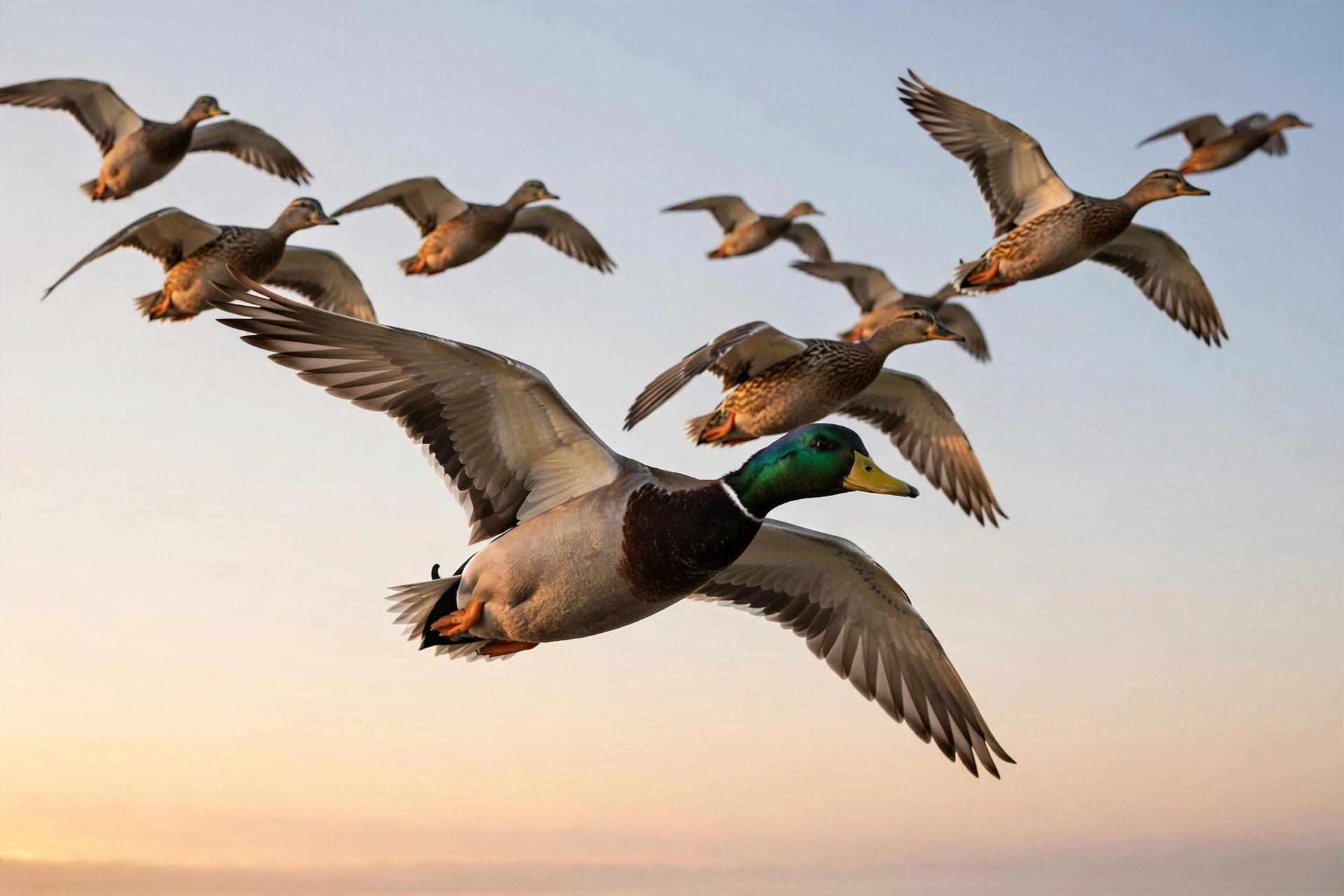
If you have glanced up this October and seen long skeins of ducks arrowing south against a pale morning sky, you have witnessed one of autumn’s great movements. Waterfowl migration is in full swing right now, with millions of ducks leaving northern breeding grounds for wintering areas further south. The flocks passing overhead this month are the advance guard of a journey that stretches from the Arctic tundra to the Gulf Coast, Mexico and beyond.
But do all ducks migrate? The answer is more interesting than a simple yes. Most wild ducks do move with the seasons, yet some populations barely budge, and a few hardly migrate at all. Some ducks fly thousands of miles nonstop over open ocean, while others spend the whole winter on the same park pond where they hatched. This guide explains where ducks go for winter, the routes they follow, how they fuel the journey, and why the ducks on your local pond may never leave.
The Short Answer: Yes, Most Ducks Migrate
Most wild duck species migrate, at least partially. Birds that breed in the far north, where lakes freeze solid and food vanishes for months, have no choice but to head south. Populations breeding further south often stay put, since open water and food remain available all winter. Biologists call this partial migration, and it is the norm across the duck family.
The mallard is the classic example. Northern mallards from the Canadian prairies travel deep into the southern United States and Mexico each autumn. Southern mallards, meanwhile, may never migrate at all. Whether an individual duck moves depends on where it hatched, how harsh the winter is, and whether open water and food hold out. This flexibility is one reason ducks are among the most successful waterbirds on Earth, and it ties into the deeper question of why birds migrate in the first place.
What Triggers Ducks to Migrate
Ducks do not check the calendar, but their bodies respond to the same signals. Shortening daylight in late summer and autumn is the primary cue that sets the internal migratory clock. As days shrink, hormonal changes prompt ducks to feed heavily and build the fat reserves that will fuel their journey.
The actual departure, however, is usually triggered by conditions on the ground. Ice forming over feeding wetlands, snow burying waste grain in fields, and dwindling aquatic plants all tell ducks it is time to move. Severe cold snaps can push huge numbers south in a matter of days, which is why hunters talk about waves of new birds arriving right after a freeze. Drought on the breeding grounds can also send ducks moving earlier than usual, since shallow potholes dry out and food becomes scarce.
Not every duck leaves at the same time. Early migrants like blue-winged teal and northern pintails often move in late summer, while mallards and other hardy species linger until ice forces their hand. This staggered schedule spreads millions of birds across the autumn months, which is why the skies seem busy with waterfowl from September through December.
The Four North American Flyways
North American waterfowl managers recognise four great migration corridors, called flyways, that funnel ducks south each autumn and north each spring. Ducks follow these routes because they link chains of wetlands, rivers and coastlines where birds can rest and refuel.
- Atlantic Flyway: runs down the eastern seaboard from the Canadian Arctic and the Great Lakes to Florida and the Caribbean, serving black ducks, sea ducks and Atlantic brant.
- Mississippi Flyway: the busiest corridor, carrying birds from the prairie potholes of Canada and the upper Midwest down the Mississippi River valley to the Gulf Coast and Louisiana’s coastal marshes.
- Central Flyway: crosses the Great Plains from the northern prairies through the rainwater basins and playa lakes to Texas, the Gulf and Mexico.
- Pacific Flyway: follows the west coast from Alaska and British Columbia through the Klamath Basin and California’s Central Valley to Mexico.
Ducks do not always stay inside one flyway. Tracking studies have recorded individual mallards shifting from the Mississippi Flyway to the Central Flyway in a single spring, proving that birds choose routes based on weather and habitat rather than fixed motorways. The flyways are a useful map, not a cage.
How Ducks Fly: V-Formations, Speed and Night Travel
The V-formation is the signature of migrating waterfowl, and it is an energy-saving strategy. Each bird positions its wingtips in the rising air, or upwash, created by the bird ahead, so trailing birds spend less energy staying aloft. Research on birds flying in formation has measured these savings directly, showing that careful positioning genuinely lowers the cost of flight. The lead bird works hardest, and flocks often rotate the position so no single duck bears the burden for long.
Ducks are powerful fliers. Most waterfowl cruise at 40 to 60 miles per hour, with migrating mallard flocks estimated at around 55 miles per hour. With a strong tailwind, they can go faster: one GPS-tracked drake mallard was clocked at 99.3 miles per hour while riding storm winds across the northern plains. Such extremes are rare, but they show what is possible when weather cooperates.
Much of this travel happens at night. Ducks often migrate after dark, flying at altitudes of several thousand feet where the air is calm and predators are few. Tracking data shows mallards commonly cruising at 4,000 to 5,000 feet on migration nights. Flying at night also lets ducks land on unfamiliar wetlands at dawn, feed through the day, and move on the next evening.
Duck Migration: A Species-by-Species Guide
Not all ducks migrate the same way. Here is how the journey looks for the species you are most likely to see this autumn.
Mallard
The mallard is the world’s most familiar duck and a true partial migrant. Birds breeding across the Canadian prairies, the northern United States and Alaska fly south to the southern states and Mexico, with some travelling well over 1,000 miles. Southern and urban populations often stay year round, which is why city parks hold mallards in January.
Mallards are late migrants by duck standards. They ride out the early cold and move mainly when ice closes their feeding waters, so peak mallard movement often falls in late October and November. They are also remarkably adaptable travellers, feeding in flooded fields and rice country along the way.
Northern Pintail
The elegant northern pintail is among the earliest waterfowl to move. Breeding across Alaska, the Canadian Arctic and the prairie pothole region, pintails head for wintering grounds stretching from coastal British Columbia and California across the southern United States to Mexico and Central America. Some cross the Pacific entirely, linking Asian and North American populations.
Pintails are strong, fast migrants that often travel at night at around 48 miles per hour. One of the longest recorded nonstop duck flights belongs to a pintail that covered 1,800 miles without landing. Their early departure means pintails are often the first ducks to arrive on southern wintering marshes. You can explore their full range and habits in Ducks Unlimited’s northern pintail profile, and Cornell’s northern pintail range overview shows how broadly these birds spread across the continent.

Wood Duck
The wood duck is a short-distance migrant, and in many areas it barely migrates at all. Breeding across the eastern United States, wood ducks move south to the Gulf states and Mexico, but many populations simply shift to the nearest ice-free water. Where winters are mild and wetlands stay open, wood ducks stay put all year.
Their story is also a conservation triumph. Wood ducks were nearly wiped out by hunting and habitat loss a century ago, and their recovery through nest-box programmes is one of wildlife management’s great successes. Today they are a common sight on autumn wetlands, and they rank among the birds on the move this October.

Teal
Teal are the sprinters of the duck world. The blue-winged teal is one of the earliest migrants of all, often leaving in August and September and wintering as far south as Central and South America. The green-winged teal travels nearly as far, breeding in Alaska and Canada and wintering across the southern United States, Mexico and Central America.
Their small size means teal must feed efficiently at every stop, and they favour shallow wetlands rich in seeds and invertebrates. Watch for tight, fast-flapping flocks twisting low over marshes in early autumn.
American Wigeon
The American wigeon breeds across Alaska and northwestern Canada and winters from the southern United States deep into Mexico, with some birds reaching Central America. Wigeon are sociable migrants that gather in large, noisy flocks on wintering wetlands, where their whistling calls carry across the water.
They are also accomplished grazers, spending more time feeding on land than most dabbling ducks. Flooded pastures and short-grass fields near wetlands are prime wigeon habitat in winter.
Sea Ducks
Sea ducks follow a different script. Eiders, scoters and long-tailed ducks breed on Arctic coasts and tundra, then move to winter on ocean waters and the Great Lakes rather than inland marshes. Long-tailed ducks gather in huge rafts on the Great Lakes and the New England coast, where they dive for molluscs and crustaceans.
The long-tailed duck is the champion diver of the duck family, recorded diving beyond 200 feet, about 60 metres, in pursuit of food. Because they winter on big, open water that rarely freezes solid, sea ducks often migrate later and over shorter distances than their inland cousins.
Migration Distances at a Glance
| Species | Breeding range | Winter range | Typical distance |
|---|---|---|---|
| Mallard | Canadian prairies, northern US, Alaska | Southern US, Mexico | Up to around 2,000 miles |
| Northern pintail | Alaska, Canadian Arctic, prairie potholes | Southern US, Mexico, Central America | Up to around 3,000 miles; 1,800-mile nonstop flight recorded |
| Wood duck | Eastern and central US | Gulf states, Mexico | Mostly under 1,000 miles; many stay local |
| Blue-winged teal | Northern US, Canada | Central and South America | Up to around 4,000 miles |
| American wigeon | Alaska, northwestern Canada | Southern US, Mexico | Up to around 2,000 miles |
| Long-tailed duck | Arctic coasts and tundra | Great Lakes, New England coast | Around 1,000 miles or more |
The Journey in Stages
Duck migration is not one heroic flight but a sequence of phases, each with its own demands.
- Fuel up: in late summer, ducks feed intensively to build fat reserves, sometimes nearly doubling their body weight in stored energy.
- Flock and stage: birds gather on productive wetlands, forming the large flocks that will travel together and gaining experience of the route from older birds.
- Depart: shortening days prime the urge to move, while ice, snow or food shortages trigger the actual takeoff, often on a calm, clear evening.
- Stop over: at intervals along the flyway, ducks land on wetlands to rest and refuel for days or even weeks before continuing.
- Arrive: on the wintering grounds, ducks settle into feeding routines, form pair bonds and wait out the cold until spring reverses the journey.
Why Some Ducks Never Leave
If migration is so successful, why do some ducks skip it? The answer is simple economics. Migration is costly and dangerous, so any duck that can survive the winter at home gains an advantage. Where water stays open and food remains available, staying put is the smarter bet.
Urban and suburban ducks illustrate this perfectly. Park ponds are often aerated or spring-fed, so they rarely freeze. People feed the ducks, and nearby lawns and fields offer grazing all winter. Under those conditions, a resident mallard avoids the hazards of a thousand-mile flight and gets first choice of nesting sites in spring. Agricultural landscapes have the same effect: waste grain in harvested fields feeds enormous wintering flocks across the southern states.
Climate also plays a role. As winters grow milder in many regions, more ducks are shortening their migrations or skipping them entirely, wintering further north than they did a generation ago. Scientists are still tracking how far this shift will go.

Stopover Wetlands: The Refuelling Stations
Between breeding and wintering grounds lie the stopover wetlands where migration succeeds or fails. A duck cannot carry enough fat for the whole journey, so it must land, feed and recover repeatedly along the way. Some stopovers last a single night; others stretch for weeks. One tracked mallard paused for three weeks near St. Louis before continuing north, feeding in flooded fields the entire time.
The best stopover sites offer shallow water, abundant seeds and invertebrates, and shelter from disturbance. Flooded rice fields in Missouri, Arkansas and Louisiana host staggering numbers of wintering and migrating ducks. Prairie potholes, rainwater basins and coastal marshes serve the same role further north. When wetlands are drained or disturbed, ducks must fly further between meals, which is why wetland conservation sits at the heart of waterfowl management.
Disturbance matters as much as food. Ducks that are repeatedly flushed by boats or hunters burn precious energy, so many refuges close key areas to give migrants undisturbed rest. A quiet wetland is a productive one.
Do Domestic Ducks Migrate?
Domestic ducks do not migrate. Nearly all farm and park duck breeds, from Pekins to Khaki Campbells, descend from the mallard, but centuries of selective breeding have made them heavy, docile and often barely able to fly. The Muscovy duck is the exception to the mallard rule, descending from a South American wild ancestor, but it is equally sedentary in domestication.
Even feral domestic ducks stay local, gathering where people feed them year round. They may wander between ponds, but they do not undertake true migration. This is worth remembering when you see a mixed flock on a city lake: the wild mallards among them may head south, while their domestic cousins, and questions of where ducks sleep at night, stay right where they are.
Frequently Asked Questions
How far do ducks migrate?
It depends on the species. Wood ducks and many mallards travel a few hundred miles, while northern pintails and teal can cover 2,000 to 4,000 miles between Arctic breeding grounds and tropical wintering areas. The longest recorded nonstop duck flight is 1,800 miles, by a northern pintail.
How fast do ducks fly during migration?
Most waterfowl cruise at 40 to 60 miles per hour, with migrating mallard flocks estimated at around 55 miles per hour. Strong tailwinds can push them much faster; one GPS-tracked mallard reached 99.3 miles per hour riding storm winds, though that is an extreme case.
Do ducks migrate at night?
Yes, ducks frequently migrate at night. Night flights offer calmer air, fewer predators and cooler temperatures. Tracking studies show mallards commonly cruising at 4,000 to 5,000 feet after dark, landing on wetlands at dawn to feed through the day.
Do ducks return to the same place every year?
Many ducks show strong site fidelity, returning to the same breeding wetlands and often the same wintering areas year after year. Banding and tracking studies confirm that individual birds follow familiar routes, though severe drought or habitat loss can force them to improvise.
Why do ducks fly in a V?
The V-formation saves energy. Each bird flies in the rising air created by the wingtips of the bird ahead, reducing the effort needed to stay aloft. Research on formation flight has measured these savings, and flocks rotate the demanding lead position so the work is shared.
Can ducks survive winter without migrating?
Yes, provided two conditions hold: open water and food. Ducks are well insulated by dense down and waterproof feathers, so cold alone rarely defeats them. It is ice sealing off feeding areas, not low temperatures, that forces most ducks south.
Conclusion
So, do ducks migrate? Most wild ducks do, travelling ancient flyways from northern breeding grounds to southern wintering wetlands, flying by night in energy-saving formations at speeds that would earn a speeding ticket. The pintails and teal passing overhead this October may be bound for Mexico or Central America, while the mallards on your local pond weigh the ice each morning and decide whether this is the year they finally leave.
The ducks that stay remind us that migration is a strategy, not a rule. Where water stays open and food holds out, from city parks to mild coastal marshes, ducks overwinter happily without ever taking to the flyways. Watch the skies this month and you will see both stories unfold at once: the great departure of the long-distance migrants, and the quiet confidence of the residents settling in for winter at home.






[…] faster than sight alone. Many waterfowl travel these same flyways, and you can read about how ducks migrate along similar […]